ONLINE ARTICLE LINK:
TEXT WITH HIGHLIGHTED POINTS IN RED:
“On graduating in 2013, Joanna Piotrowska already seemed fully formed as an artist. For her diploma show at London’s Royal College of Art, she presented a series of large-format, black-and-white photographs titled Frowst – meaning stuffy or stifling – that are quietly unsettling. People in domestic settings are positioned touching or holding one another: small groups at once intimate and weirdly disengaged. Uncanny, deadpan expressions quash the idea that these photographs might document actual events, yet the subjects’ physical ease with one another seems real.
“I was concerned with relationships between family members – how they can be uncomfortable, oppressive, unhealthy and dependent,” says Piotrowska. Posed using real families, her works distil the off-kilter claustrophobia of a Yorgos Lanthimos movie into a single frame. Last year, a handful of her Frowst works were shown at MoMA in New York. This week, All Our False Devices, a solo display of more recent photographs and films, opens at Tate Britain.
Ahead of our meeting at her studio flat in London, Piotrowska has unrolled a stack of massive prints from Frowst on to the kitchen floor. They are, she says, as big as you can go with a hand-printed black-and-white photograph. She flips casually through the images, throwing them from one pile to another and holding them flat at the edges with stacks of books. As a viewing experienced, it is far removed from the reverent sterility of Tate or MoMA.
Smaller piles of photographs cover the table and we lay them out casually around stoneware mugs of tea. These are from the two series that will be shown at Tate. For one, she has posed women in positions derived from self-defence manuals. For the other, she invited participants to build themselves shelters out of their possessions. Like Frowst, both were shot in unremarkable domestic settings, their subjects coolly detached and their mood enigmatic.
Planning a photograph of siblings a few years ago, Piotrowska started leafing through their old family albums and came across a picture of them as children playing in a little den. She invited them to stage something similar, and was pleased with the result. “They did it in a very simple way,” she says. “It was so ambiguous. On the one hand, it was about a private moment in domestic space. But the shelter is also a way of withdrawing from what’s around you.”
Piotrowska began to think about vulnerability and protection in different ways, from the housing crisis to her physical sensations of anxiety. In her home country of Poland, women were donning black and taking to the streets to protest the tightening of abortion laws and fighting state control over their bodies. Here in London, Piotrowska was keenly aware of her own precarious residence status.
The series of shelter photographs were shot across multiple cities – London, Lisbon, Warsaw and Rio de Janeiro – in which concerns about personal security differ sharply. Each little structure gives a miniaturised view into the subject’s life: the objects they surround themselves with and their relative desire for comfort, elegance or solidity.
“The shelter is like a fortress for our bodies, an extension of our selves. It is about how we choose to live, what we’ve surrounded ourselves with,” she says. “It’s also a little absurd that an adult is building this temporary, fragile structure. It isn’t really giving us any protection because it’s so ad hoc.”
Piotrowska is bookish: the title of her Tate show is taken from a Philip Larkin poem, and her work is often inspired by feminist and psychology texts. Frowst relates to the alternative group therapy of German psychotherapist Bert Hellinger, founder of a method called Family Constellations, in which the positioning of bodies in relation to one another is subject to analysis. The series using self-defence poses was inspired by American feminist and psychologist Carol Gilligan, whose book In a Different Voice explores how girls learn to police themselves to conform to societal expectations.
“I had been very concerned about vulnerability and the position of women,” says Piotrowska. “The figures in in self-defence manuals were obviously men. I wanted to start staging these positions with women in domestic spaces. We need to defend ourselves and use our bodies as a weapon.” As ever with Piotrowska’s photographs, the results are ambiguous and disconcerting. The calm poise with which these moments of ritualised combat are undertaken suggests acquiescence as much as it does aggression.
Piotrowska has started to see private interactions of the family unit as society’s hidden underbelly. She is fascinated as to how anything functions while balanced on these odd, intimate relationships, hovering, as she sees them “between love and care and something a bit more aggressive”.
Evaluation
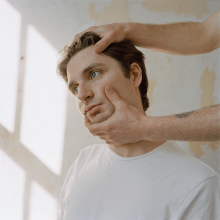
Throughout my current research and visual representations of my own siblings relationships I have been experimenting with the idea of physical contact between myself and my brothers. When looking at the studio portraits myself and my brothers had yearly I noticed the lack of physical contact between us, as in all of the photographs we stand with our hands in our pockets, having no contact with each other. This then led me to thinking about the ways in which contact can represent aspects of the relationship, particularly uncomfortable contact and controlling contact (hugs and holding each other face). In this article, the work by Joanna Piotrowska is described as ‘disengaged’ and unsettling’ which is the way in which I feel my own photographs feel. There is an atmosphere of discomfort and disconnect that I also feels represents the way in which our relationship is. As seen in the studio portraits, we are not a naturally affectionate family, but in my own images I have forced that physical contact onto myself and my siblings, with an uncomfortable result. Something that has really stood out to me is, “between love and care and something a bit more aggressive.” due to the way in which siblings control each other, this is done with care and through love, but there is always going to be something aggressive and controlling about it. It is about power, dominance and possession of another person, and I feel that the way in which I have forced physical contact embodies this aspect of the relationship.
While this article is about a body of work based around domestic scenes I feel that its themes and the effect of the work is very similar to my own. Piotrowska uses domestic spaces to put the peoples bodies into the context of every day living, and therefore, everyday struggle of domestic life. However, in my own work, I have done a combination of domestic space, and outdoor natural environment. The shoots in domestic space are those made of Rowan and Jack embracing each other, and holding each others faces. These were made in my old bedroom, which has derelict walls and has done for years. I decided to use this space as I felt shooting them in the room I grew up in put myself in the work, as they were entering my space, but they were still the focus of the images. I also felt that the way in which the walls were covered in ripped wall paper could either indicate a break or damage or perhaps the representation of time passing and people growing older away from their domestic spaces. When I was shooting on the beach, the relevance was where we are from, Brighton, we all grew up near the sea and for me this feels like home even more so than my old bedroom. I also wanted to include this space as none of us can swim due to our Dad. As I mentioned previously, our shared Dad is a big aspect to the project and has been a strong influence on us, therefore our shared inability to swim stems from him and is a strange indicator to our desire to be like him when we were children. While my use of space differs from Piotrowska, I have also used domestic space and public space in order to emphasise the themes and ideas behind the work. My spaces and locations are very personal to me, and the viewer would be unaware of these connections, however I feel that visually, they do embody elements of the relationship that I am trying to represent.
REFERENCE:
Judah, H. (2019, March Thursday 7). Gimme Shelter: Joanna Piotrowska on her unsettling domestic scenes. Retrieved from Gimme Shelter: Joanna Piotrowska on her unsettling domestic scenes: https://www.theguardian.com/artanddesign/2019/mar/07/we-need-to-defend-ourselves-joanna-piotrowska-family-photographs-tate-britain?CMP=share_btn_fb
 phoebebowdige.photo.blog