TEXT:
NOTES AND CLIPPINGS FROM READING:
- “Animals play just like men. We have only to watch young dogs to see that all the essentials of human play are present in their merry gambols. They invite one another to play by a certain ceremoniousness of attitude and gesture. They keep to the rule that you shall not bite, or not bite hard, your brother’s ear. They pretend to get terribly angry. And-what is most important-in all these doings they plainly experience tremendous fun and enjoyment.”
- “If we call the active principle that makes up the essence of play, “instinct”, we explain nothing; if we call it “mind” or “will” we say too much. However we may regard it, the very fact that play has a meaning implies a nonmaterialistic quality in the nature of the thing itself.”
- “According to one theory play constitutes a training of the young creature for the serious work that life will demand later on. According to another it serves as an exercise in restraint needful to the individual. Some find the principle of play in an innate urge to exercise a certain faculty, or in the desire to dominate or compete.”
I found this Homo Ludens reading by Johan Huizinga less relevant to my work than Dennis K. Orthner’s Familia Ludens. Homo Ludens covers more of the general idea of play within humans as appose to relating it back to the family. However, aspects of the reading does relate to my initial themes of aggression and fighting, as I feel there are links between human play and human fighting. Many children and siblings play fight through out childhood and Huizinga suggests this playing is a natural aspect of human behaviour that can be compared to that of animals. He states that the way in which men fight or ‘play’ can be directly compared to behaviours in the animal world, ‘We have only to watch young dogs to see that all the essentials of human play are present in their merry gambols. They invite one another to play by a certain ceremoniousness of attitude and gesture.’ This explanation of the behaviour almost excuses it to be purely down to nature, however personally, I feel that the social elements of humans make this type of behaviour unacceptable, and therefore it cannot be purely put down to nature and instinct.
Another aspect of the reading that I found interesting was the way in which play behaviour can be connected to the ‘desire to dominate’, which is a relevant idea in the concept of siblings. When siblings play fight, they are generally doing so for fun, however the natural reasons for this behaviour may have an underline tone of wanting to over power each other. This aspect can be carried on into adult life for siblings, and while fighting (in some cases) does stop, and the siblings no longer play-fight, there are elements of needing to dominate or control one another in psychological and social ways.
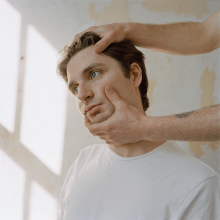
I feel that I have applied this idea of play, natural aggression and fighting in my moving image piece. While I have not included any literally fighting or aggressive physical contact in the piece, I feel that the way in which I have played the moving image diptych and triptychs have implied the aggression, as the boys stare at each other from different frames in a pre-fight-like way. Moreover, I have applied my understanding of control, also inspires by Prophecy Coles’s Sibling Relationships and photographers such as Nellie Palomaki in my portraits of Rowan and Jack as I have used ideas of control and dominance suggested by Huizinga.
REFERENCE:
Huizinga, J. (1938). Homo Ludens.
 phoebebowdige.photo.blog